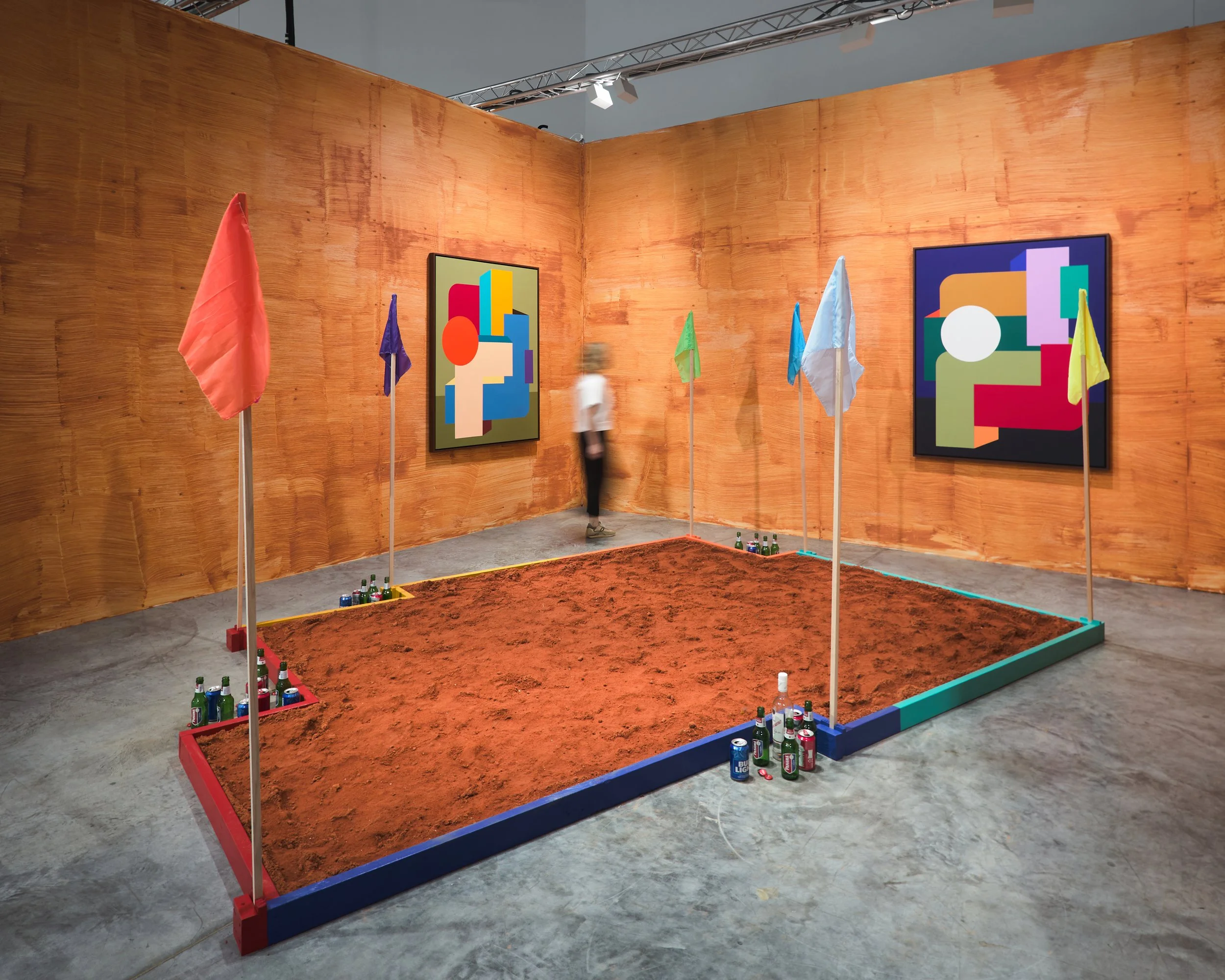
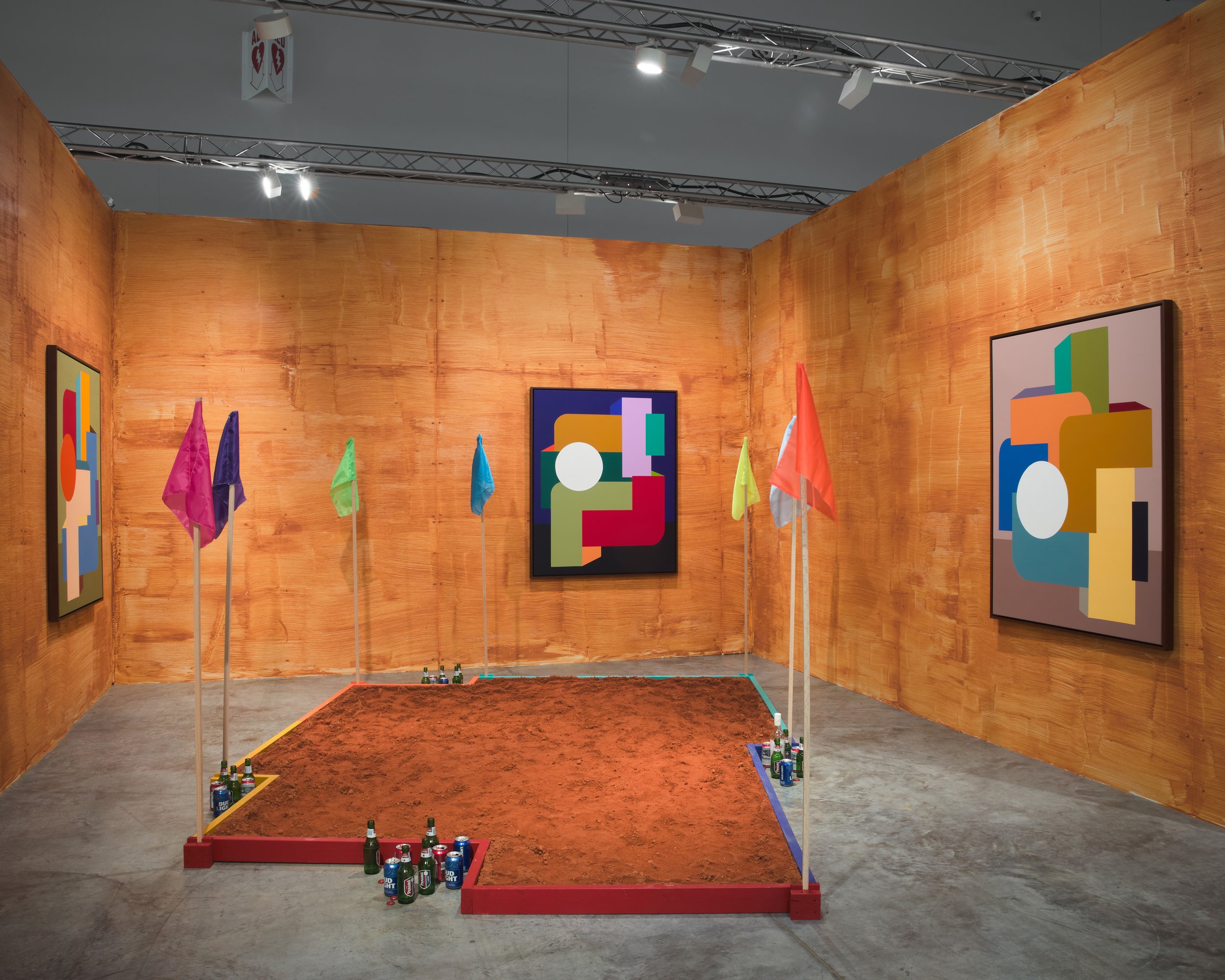
Zielinsky presents, for Positions sector at Art Basel Miami Beach, Los panameños del parque de Miami, a solo presentation by the Chinese-Afro-Panamanian artist Cisco Merel (b. 1981). The booth features three works: an installation activated by Latin American art assemblers and friends in the days leading up to the fair’s opening, a mural created with a mixture of Panamanian and Miami mud, and a series of paintings on canvas. In his new body of work, Merel explores themes that touch on the perspectives of the so-called ethnographic turn in contemporary art from a situated point of view: people, blood, and land (with “people” understood as community, “blood” as ancestry, and “land” as a place of affection).
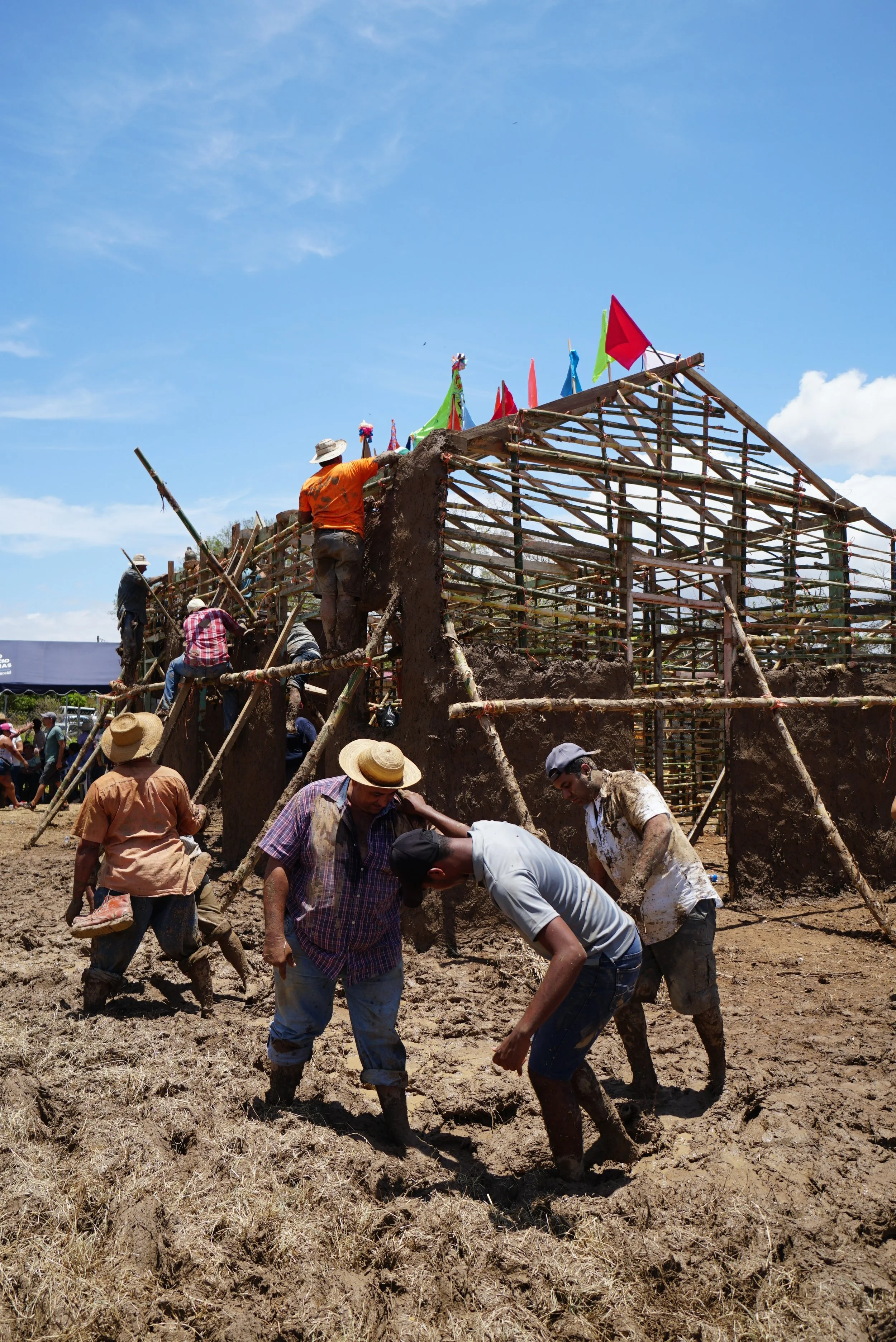
Cisco Merel engages conceptually with the recovery of traditional techniques in the creation of his works, while also exploring geometry that intersects Western elements with Mesoamerican cosmovision. Working from the Panamanian context, the artist uses mud not only as a material but as a medium that allows him to recover the communal work dynamics present in the traditional collective process of building quincha [mud/ adobe] houses. The earth, as a building material, is also a home; as an element of identity, it carries symbolic and ideological meanings; as a container of Pre-Columbian cosmology; and, in a conflicting way, it also embodies the popular: indigenous, mestizo, and criollo.
A new version of the work ‘La Pisada’ [The Tread] will be created for the gallery booth. The sculpture, made from earth, straw, and wood, will be activated in the days leading up to the fair’s opening by friends and Latin American art assemblers. The stepping action, titled ‘Junta de Embarra’, is an ancient construction technique used in rural Panamanian communities to build quincha houses. The sculpture-structure takes the form of a house, simulating a construction site and delineating the area. Another key element is the inclusion of flags, representing the people participating in the action, along with alcohol, music, dance, and entertainment—elements that evoke rural rituals. The piece aims to capture the communal gesture of stepping as the central focus of the experience, reflecting the solidarity formed among participants. After the activation, the beer bottles consumed by participants will be kept in the booth.
Lastly, the booth will feature a mural. All three walls will be painted with a mixture of mud from Panama and Miami, creating a backdrop for the artist’s other three canvas paintings. Following his participation in the Panama Pavilion at the Venice Biennale and his solo show “Gate of the Sun” at the Museo de Arte Contemporáneo de Panamá, the artist shifts his investigation to explore the notion of community, as well as three-dimensional forms that could only exist in the realm of painting or in visions experienced during deep sleep, under the influence of alcohol or psychoactive substances in rituals.
Seen in sequence, the paintings in this new series appear as an alternative musical notation system that uses chromatic and geometric iterations to represent changes in intensity, melody, and rhythm. Each one represents a fixed moment in the constant process of restructuring undergone by a mysterious modular object. Cisco conceives this object as a “hyperlith”, a kind of fantastic megalith created by his delirious imagination. This living totem – which changes shape, color, and context in a fluid and random manner – could represent an oracle, a sacred marker, or a cosmic effigy from his personal pantheon. For the artist, fixed on canvas some isolated moments of the continuous chain of structural mutations that his imaginary hyperlith undergoes is a way to explore sculpture through the two-dimensionality of painting, allowing a dialogue between the two forms. The division of each background into two slightly varied tones suggests a horizon, a simple gesture that creates a subtle sense of amplified spatiality. Merel creates particular atmospheres and settings for each individual permutation of the shifting and mystical hyperlith.
The title of the project, ‘Los panameños del parque de Miami’ [The Panamanians of Miami Park], was taken from a Facebook community. While not the most popular social network among the Latin community in the U.S., it remains an important space for socializing. Its members use it as a platform to share their achievements on American soil, as well as their musical tastes, traditional foods, inside jokes, and parties, where their Panamanian identity is proudly expressed to the sound of a cumbia sung in Spanish with a slight English accent.
_____________
Cisco Merel (b. 1981, Panama City, Panama) uses abstraction as a means to explore themes such as architecture, social contrasts, and popular art. Through his work, he seeks to reconnect with the origins of the constructive and sociocultural systems that shape our present.
Recently, he held the solo exhibition La Puerta del Sol at the Museo de Arte Contemporáneo de Panamá, curated by Juan Canela. Additionally, for the Venice Biennale, Merel contributed an installation for the Panama Pavilion. Over the past years, he has participated in various group exhibitions, including The Appearance: Art of the Asian Diaspora in Latin America & the Caribbean at the Americas Society, New York, USA; Detrás del muro at the Havana Biennial, Cuba; Trampolín at the Centro Cultural de España, Panama; Circles & Circuits – Pacific Standard Time at the Chinese American Museum, Los Angeles, USA; Bienal del Istmo Centroamericano in Tegucigalpa, Honduras; and The State Of L3 Collective at the Museum of Contemporary Art, Antwerp, Belgium.